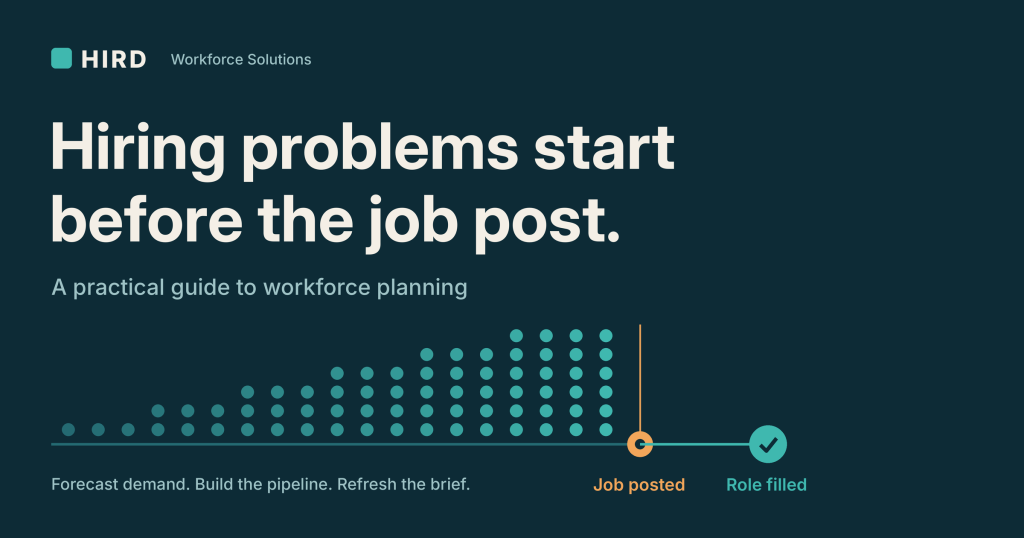
Most companies believe they have a hiring problem. Roles stay open too long, good candidates drop out, and teams are stretched thin. But in most cases the real issue is not recruiting. It is workforce planning, the work that should happen months before a job is ever posted.
In this guide, we explain what workforce planning is, the warning signs that your organisation is hiring reactively, and a simple five-step process to fix it.
What Is Workforce Planning?
Workforce planning is the process of forecasting the talent your business will need, comparing it with the talent you already have, and building a plan to close the gap. It answers three questions:
How many people will we need, and by when?
Which skills will we need that we do not have today?
What mix of permanent, contract and flexible talent fits each need?
When these questions are answered early, hiring becomes a planned activity instead of an emergency.
4 Warning Signs You Are Hiring Reactively
1. Roles are opened in panic, not in plan. A resignation arrives, and only then does the search begin. By the time the role is approved and sourced, the team has already lost weeks.
2. Job descriptions are copied from three years ago. The business has changed, the role has changed and the talent market has changed. An outdated brief attracts the wrong candidates, or none at all.
3. Offers go out slowly. Strong candidates usually have more than one option. Long interview cycles and delayed feedback mean the best person accepts elsewhere.
4. Attrition is treated as a surprise. In most organisations, the signs of attrition are visible months in advance: falling engagement, stalled growth, manager changes. Planning means acting on those signals early.
The Real Cost of Reactive Hiring
Reactive hiring rarely shows up as a single large expense. It shows up everywhere:
Longer time-to-fill and more days of lost productivity
Higher cost per hire, because urgency limits your options
Compromise hires made to end a long search
Overworked teams and, in turn, more attrition
The cycle repeats because each rushed hire creates the conditions for the next vacancy.
How to Build a Workforce Planning Process: 5 Steps
Step 1: Forecast demand
Look 2 to 3 quarters ahead. Use business goals, expected growth, projects and known attrition to estimate how many people and which skills you will need.
Step 2: Audit your current workforce
Map the skills, roles and capacity you already have. Identify critical roles, single points of failure and people who could be developed internally.
Step 3: Close the gap with the right talent mix
Not every need should be a permanent hire. Some roles suit contract or flexible talent, and some are better built through executive and leadership hiring. Matching the model to the need keeps costs and risk in balance.
Step 4: Build talent pipelines before you need them
Keep a ready pool of qualified candidates for your most critical and most frequently hired roles. This is where recruitment process outsourcing (RPO) is especially effective, because an RPO partner works on your pipeline continuously, not only when a vacancy appears.
Step 5: Set speed rules and review quarterly
Agree on simple standards, such as interview feedback within 48 hours and a maximum number of interview rounds. Review your plan every quarter and refresh role briefs as the business changes.
Permanent, Contract or Flexible: Choosing the Right Mix
Need
Often a good fit
Core, long-term capability
Permanent hire
Project-based or seasonal demand
Contract talent
Uncertain or fast-changing demand
Flexible workforce model
Senior, high-impact roles
Specialist leadership search
Once people are in place, administration matters too. Reliable payroll and workforce management and HR outsourcing keep your internal team focused on growth rather than paperwork.
When to Bring in a Workforce Partner
You may benefit from outside support if:
You hire in volume or across several locations
Critical roles stay open for months
Your HR team is busy with day-to-day work and cannot plan ahead
You need access to talent you cannot reach through job boards alone
At HIRD, we work on the part that sits before the job posting: forecasting demand, building talent pipelines and structuring the right workforce mix. You can learn more about HIRD or explore all of our workforce solutions.
Frequently Asked Questions
What is the difference between workforce planning and recruitment?
Recruitment fills a specific vacancy. Workforce planning decides which roles, skills and talent models the business will need in the future, so recruitment can be faster and more targeted.
How far ahead should companies plan their workforce?
Most organisations plan 2 to 3 quarters ahead for hiring and 12 months ahead for broader skills needs, then review the plan every quarter.
How does workforce planning reduce time-to-fill?
Because pipelines, role briefs and approvals are ready before a vacancy opens, the search starts immediately instead of weeks later.
Is workforce planning only for large companies?
No. Growing and mid-sized companies often benefit most, because a single unfilled role has a larger impact on a smaller team.
What is RPO and how does it support workforce planning?
Recruitment process outsourcing means a partner manages all or part of your hiring process. It supports planning by providing continuous sourcing, market insight and scalable capacity. See our RPO services for details.
Conclusion
Hiring problems are usually planning problems in disguise. When you forecast demand, build pipelines and agree on clear hiring standards, you replace urgent, expensive searches with a steady and predictable process.
The best hiring decision is often the one you planned six months ago.
Planning your next phase of growth? Talk to the HIRD team about building a workforce plan that fits your business.
Related reading: Add related blog title 1 | Add related blog title 2






 1.svg)


.svg)